To keep your goats safe, you need to provide them shelter. How elaborate your goat shelter is depends on where you live, what structures are available, how much you can afford, and how many goats you plan to have in the shelter. Some of the things to consider when deciding where your goats will live include:
Flooring: Dirt or gravel floors are best, although some people prefer wood. Dirt absorbs urine, and both gravel and dirt, when covered with straw, are warm. Avoid concrete because it's cold and hard on the goats' bodies, although it's easier to clean.
Bedding: Regardless of type of flooring, you need to use some sort of bedding for warmth and comfort. If you do have to use a concrete floor, make sure to put down 3 to 4 inches of wood shavings or straw to insulate the goats.
Dimensions: Consider the height and width of the shelter. Goats need to have 10 to 15 square feet of housing if they also have an outdoor area. When building, think about how easy it will be to muck out old bedding. Having to bend over or stretch a long way while mucking is uncomfortable and hard on your back, so if the goat shelter you build won't be taller than you are, don't make it too deep.
Climate: An open shelter may be fine in a mild, dry climate with good fencing from predators, but it won't work in an area of heavy snow and wind or the open range. Make sure that your building is in an area with good drainage and, if it is open, that it faces away from the prevailing wind.
Herd composition: If you have or plan to have a lot of goats, you need to make sure you have a large enough structure or plan to build more shelters over time. Groups such as bucks, does, and kids to be weaned need separate housing areas.
Storage: Remember that you need to have an accessible (to you, not the goats) place to store feed and goat-care tools.
Access to water: Having easy access to water, but it isn't critical in most cases. Just remember that if you don't have a water source close to your goats' area, you'll be hauling water every day for a long time.
Other considerations: Regardless of the breed, you need an area for doing routine care, such as hoof trimming or clipping. If you're raising dairy goats, you can use the same space for milking. In addition, if you're planning to breed your goats, you need kidding pens, which can be 4 feet by 5 feet; the number that you need depends on how many goats are kidding at one time. Plan on leaving your goats with their babies in kidding pens for two to three days, and make sure that you stagger their breeding so they have a place to go.
Monday, June 2, 2014
Monday, May 12, 2014
Miniature Dairy Goat Breeds
If you want to raise goats to promote a more sustainable lifestyle, but you have limited space or don't want to be drowning in goat milk, the miniature dairy breeds might be good choices for you.
Miniature breeds are relatively new to the scene but are growing in popularity. Miniature dairy goats include Nigerian Dwarves, Pygmies, and the most recent development in dairy goats in the United States: miniature, crossbred versions of the standard breeds, called minis. Check out these miniatures:
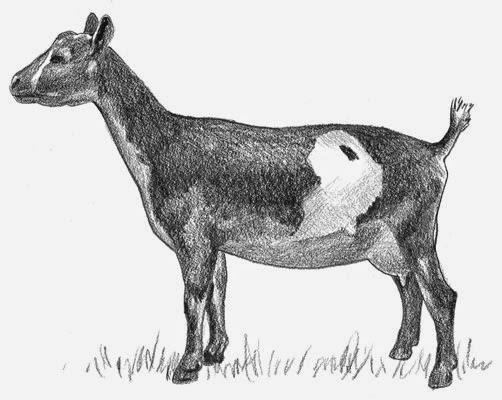
Nigerian Dwarf: Nigerian Dwarves came to the United States from Africa. They are not true dwarves because they are proportionate in size. They are colorful, friendly, easy to handle, and in some cases good milk producers.
The Nigerian Dwarf Goat Association allows 17 to 21 inches for does and 19 to 23 inches for bucks, while the American Goat Society allows a maximum of 22.5 inches for does and 23.5 inches for bucks. They average around 75 pounds.
Some urban goat farmers shy away from the Nigerians, despite their petite size, because they can be loud. But their kids are the cutest things around, and Nigerian Dwarves have a lot of them. The does tend to be easy kidders and natural mothers.
Some Nigerian Dwarves give only about a pound (one pint) of milk per day, but others produce as much as 8 pounds (a half-gallon). A lot of them are hard to milk because of their small teats, but others have been bred to alleviate this problem.
You can eat a Nigerian, but most people don't. It isn't cost effective, and besides, they're so darn cute!
Pygmy: Pygmy goats aren't usually considered dairy goats, but they can be milked. Most of them are raised as pets or 4-H projects, but a small minority of breeders raise them for milk. The Pygmies raised for milk tend to look more like Nigerians in body shape. If you want Pygmies for milk, make sure to ask whether they're registered with the American Goat Society and whether the breeder is milking them.
Pygmies have been bred to be short and stocky and are more limited in color, ranging from white to brown to black with only minor variations. Because they have been bred down to a short, compact size, Pygmies often have problems kidding and need the services of a veterinarian for cesareans. They are not quite as prolific as the Nigerians, either.
Kinder: The Kinder is a moderate-sized breed that was developed in Washington and first registered in 1988. It is a cross between the Pygmy and Nubian breeds. Kinders are good dual-purpose (milk and meat) goats that are ideal for family farms.
Minis: If you really like one of the standard breeds but are in the city or just don't have the space for big goats, minis are ideal. These goats are a cross between a Nigerian Dwarf buck and a doe of the breed you want to miniaturize.
Monday, April 14, 2014
Alpine Dairy Goats
The Alpine Dairy Goat is also referred to as the French Alpine and registration papers for this dairy goat use both designations and they are synonymous. The Alpine dairy goat is a medium to large size animal, alertly graceful, and the only breed with upright ears that offers all colors and combinations of colors giving them distinction and individuality. They are hardy, adaptable animals that thrive in any climate while.
The Alpine goat is referred to as the French Alpine goat. Known for its milk, the Alpine goat is famous for its rich dairy production. Alpine milk contains the lowest fat content of all milks(3.1 g/ 250ml), including that of Human’s and cows. It is higher in Sugar’s than cow’s milk but balances it self in terms of the amount of protein. Alpine Goats milk has 2.3g of protein per 250ml while Cow’s milk has 3.4. A higher protein count is not always good, since it packs more calories with a increased fat content. Compared to Saanen Goat Milk, it is higher in all nutritional aspects. Except the fat content. Making it a much better choice.
Thursday, March 20, 2014
Pig Farming - 4 Key Factors For Beginners
Remember that the learning process should be in a slow and steady manner. You have to balance keeping your business sustainable while at the same time learning new things to further improve your farm. Starting a pig farm should always include doing research, and making the most out of your resources. Keep in mind that profit is the goal, but you should not compromise the health or overall status of your farm. In order to achieve the later, you really should be prepared to make a good investment. This would include equipment, animals, workers and other related particulars.
During your planning, you might have this notion that pig farming is a dirty job. In reality, pigs are actually very clean creatures. They only seem to look filthy because of the fact that they tend to wallow in mud or water. Well, the level of cleanliness in your farm would actually depend entirely on your management practice or scheme. Keep in mind that like people, your animals also eat, sleep and defecate so they need regular cleaning, feeding and medication to keep them healthy. After all, you will be selling these pigs for human consumption so they need to be quite hygienic.
The good thing about pigs is the fact that they do not excrete their wastes (urination and defecation) in the same place where they sleep. Even inside a pen, you would notice that a particular area of the pen is designated as the "bathroom". What is the significance of this?
Well, when farming pigs you must understand that cleaning would be much easier to facilitate when you have small gutters on the side of the pen. Also, it is more ideal to have sloped flooring for your pens since this would facilitate the movement of excretions from the pen floor towards the gutter. This is less laborious and more efficient than having to consistently scrub the floor. Bear in mind this principle when you are constructing pens for your farm.
Aside from the flooring and pen design, your building should be constructed well. This means that you should have proper ventilation within the pen so as to keep the air circulating. Remember that feces and urine would have a bad or offensive odor which can also be irritating for pigs, so circulation of air is very important. This also helps to prevent the accumulation of noxious substances such as ammonia in the building. Just be cautious that your building should not be too breezy or allow too much draft to enter since this can cause pneumonia and/or other respiratory problems.
Pig farming may seem like a really big task that can easily overwhelm someone who does not have the right information and does not understand the science behind it. Just always bear in mind that before you begin with your pig raising business, you should have given it enough thought and research so that you will be able to raise healthy and very productive animals. Pig farming may not be a piece of cake but with the power of information and the right set of tools, you will surely be able to turn your business into a success story.
Thursday, February 27, 2014
Goat Farming
Animal husbandry, is one of the oldest profession that has been taken up by mankind. This profession has been highly instrumental in providing the mankind with #meat, #milk and leather. Today, there are many scientific techniques that have been introduced in the #animal husbandry, which has made the activity more fruitful and economically successful. #Farming of #goats for milk and meat supply is one such technique.
The domestic goat, which is also known as Capra aegagrus hircus, was domesticated from the wild goat, when man started settling down and started the development of civilization. It has been suggested that one of the initial attempts of domesticating and rearing goats started in Eastern Europe and Asia. The goat is also one of the animal that has been tamed very easily by mankind.
Cows and larger cattle is tamed and used on large farms, that are termed as ranches. Earlier, goats were domesticated only by nomads on a very small scale, with very few number of goat farms in operation. Of late rising food prices, and rising operational costs has led to the development of many goat farms across the world. The advantage of goat farms is the goats are very easy to maintain, and at the same time, they can also be used for multiple profitable purposes.
One of the most valuable product that is derived from goats is goat meat. In many nations around the world, goat meat is known as 'mutton'. On the other hand, in nations such as the United States, the meat is known as 'chevon'. It must be noted that chevon or mutton contain much less fat and cholesterol than any other type of meat. The low fat and cholesterol are probably the explanation for the rising demand of goat meat. Goat meat is used in several different recipes in different forms such as stewed, baked, baked grilled and barbecued meat. Rearing them for meat has thus become a very profitable business. Some goat breeds that have gained widespread popularity as a result of their meat are:
Goat milk is very nutritious and can be used in many different agro-processed foods such as butter, cheese and cream. Goat cheese is often termed as chèvre. Goat milk is also often used to make the famous Mexican Cajeta, which is a very sweet drink. The milk of goats is extremely nutritious. It basically contains almost no fats and is a reservoir of proteins. The nutrients that are derived from the goat milk are also healthy and are not stored away by the body as fats. In any rural areas, especially in South East Asia, goats are domesticated by rural populations, for its healthy milk. The basics of farming are provided to many people from rural areas for this purpose. Breeding and boarding of goats for their milk and milk products has thus become a very profitable business in many rural areas.
There are many other factors that you will need to consider, while framing a business plan for farming. The goats provide us with effective and sturdy fiber. You can also purchase wool bearing goat breeds such as Angora goat and Cashmere goats. The wool that is provided by these goats is very strong and can be used to make woolen clothing.
Rearing goat for profit is an upcoming venture that can be used to churn out cheap meat and milk supply. The farming of goats will also involve the breeding, care and welfare of this vital farm animal.
Wednesday, February 5, 2014
Return of the bat: European species make a comeback
#Bat numbers – collected from 6000 hibernation sites in nine #European countries – have increased by 43 per cent between 1993 and 2014, according to a new report by the European Environment Agency (EEA). The study, which tracks 16 of Europe's 45 bat species, is the most comprehensive population study of #bats on the continent to date.
"This trend is a definite sign of hope," says Karen Haysom, director of science at the British Bat Conservation Trust, a partner in the study.
Armed with a statistical method that proved key in earlier EEA studies of European butterfly and bird population trends, Haysom and her collaborators input decades of national bat data into a dataset that revealed how bat numbers changed from winter to winter according to species and region. Never before had such data – reported by scientists and also by thousands of amateur bat enthusiasts, who counted hibernating #animals in local caves and other roosts – been consolidated over such a broad time span and geography, Haysom says.
"This is giving us a chance to put our numbers in a different and very valuable context, and think about why some bat species are doing well in some countries compared with others," she says. Population trends were calculated in Latvia, Hungary, The Netherlands, Austria, Portugal, Slovenia, Slovakia, Germany and the UK.
Friday, January 10, 2014
Ralph, World's Largest Bunny Rabbit, Weighs 55 Pounds And Eats $90 Of Food A Week !
Ralph, a 4-year-old Continental Giant from the United Kingdom, reclaimed the Guinness World Record for the largest #rabbit.
The bodacious #bunny binges on about $90 worth of #food a week. Each insane daily meal includes #cabbage, #broccoli, #corn on the cob, half a cucumber, a #carrot, sweetcorn, two slices of brown bread, two #apples, half a bag of watercress and crackers.
"Ralph has matured now and is the heaviest he has ever been," his owner, Pauline Grant, told the Daily Mail.
She cares for Ralph at her horse rescue facility in East Sussex, and relies on donations from visitors to help feed the behemoth. She says Ralph is "fine and healthy."
"We have got a big place here and he can go anywhere he wants. He has a fantastic life and is not just kept in a hut. His diet is incredible," she said.
He comes from a line of gentle giants. His mom, Amy, held the record for biggest #bunny until she died of a heart attack four years ago, and his dad's heft earned the previous record.
Subscribe to:
Posts (Atom)


.jpg)

.jpg)